Reject Woodfibre LNG and FortisBC’s toxic air pollution permits.
198 signed. Let's get to 250.
Woodfibre LNG and FortisBC have both applied to discharge toxic air pollution into the Átl’ḵa7tsem / Howe Sound airshed.
This is the only opportunity for people living in nearby communities to assert your right to a clean and healthy environment, identify if you could be adversely impacted, and demand air quality monitoring and permit conditions that will protect public health and the environment.
IMPORTANT! Personalized letters are much more impactful. See the example speaking points below. Email tips@myseatosky.org if you want help putting together your letter.
DEADLINE: November 30, 2026
What is happening?
Woodfibre LNG has submitted application No. 455458 to discharge toxic air pollution into the Átl’ḵa7tsem / Howe Sound airshed. FortisBC has also submitted a separate application No. 437833 to discharge toxic air pollution from its compressor station located at the Woodfibre site. You can access the information provided at Woodfibre LNG's open houses here.
What can you do?
Send a personalized letter to the BC Energy Regulator to:
1. Assert your right to a clean and healthy environment.
The United Nations has recognized the right to a clean, healthy and sustainable environment as an inherent human right. Federally, Canada has also recognized the right to live in a healthy environment, which includes the right to live free from pollutants, contaminants, or harmful substances.
To fulfill this right our governments must regulate effectively, engage in robust supervision and monitoring, and require impact assessments.
They must take steps to protect vulnerable groups, and take measures to:
- Safeguard biodiversity
- Ensure clean air
- Apply the best available scientific knowledge
- Provide meaningful and effective remedies
2. Identify if you could be adversely impacted.
Do you or a family member have any health conditions that make you vulnerable to air pollution? Do you have young children? Are you planning to start a family? Are you a senior? Which community do you live in? Did you live in Squamish or Britannia Beach when the Woodfibre pulp mill was operating prior to closure in 2006, and did you ever smell the pollution from that?
This is the only opportunity for people living in nearby communities to document how they could be adversely affected by the approval of these permits.
3. Demand baseline + continuous air quality monitoring and enforceable permit conditions that will protect public health and the environment.
Tell the BC Energy Regulator to reject this permit application and require Woodfibre LNG to:
- Establish a speciated air quality baseline throughout Átl’ḵa7tsem / Howe Sound of the pollutants that are toxic to human health for one year before operations start, including: benzene, fine particulate matter (PM2.5), black carbon, ozone, the acid gases, nitrogen dioxide, other nitrogen oxides, sulphur dioxide, coarse particulate matter (PM10), hydrogen sulphide, total reduced sulphur, ethylbenzene, carbon monoxide, xylene, toluene, and non-methane hydrocarbons, and;
- Require enforceable permit conditions to continuously monitor and publicly report — in real-time — the concentrations of compounds known to harm health and the environment during operations, which obligate the regulator to act to protect public health when any air quality condition is violated.
How will air pollution harm the health of nearby residents?
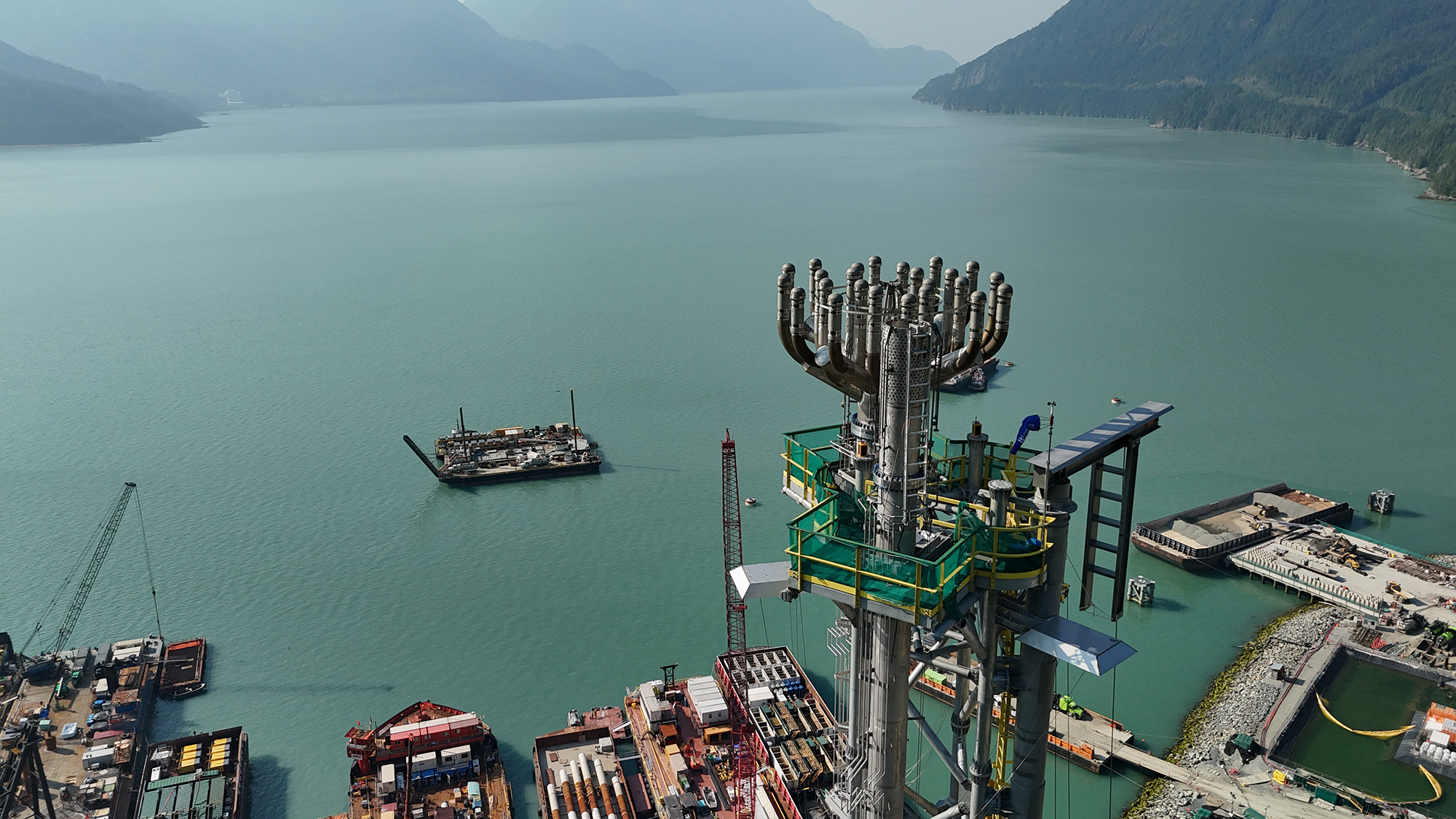
As Woodfibre LNG moves towards start-up in mid-2027, there will be several sources of toxic air pollution from the liquefaction facility, its 134 metre high flarestacks, FortisBC's associated gas-powered compressor station, and LNG carriers / tugs. These components will emit significant air pollution including hydrocarbons, nitrogen oxides, sulphur dioxide, hydrogen sulphide, particulate matter, and volatile organic compounds such as benzene, all of which are known to harm human health even over short exposure periods. Potential health risks include increased asthma, heart attacks, pre-term birth, certain cancers, and early mortality. Seniors and youth are most vulnerable. LEARN MORE
Why do we need baseline air quality monitoring?
In its 2015 application for an environmental assessment certificate, Woodfibre LNG claimed that start-up flaring would last for one month. Now, Woodfibre LNG estimates that flaring during start-up and early operations will last approximately three years, and the flare will be up to 90 metres high.
Baseline air quality monitoring allows us to identify what is in the air we breathe now, before Woodfibre LNG and FortisBC start polluting, so we can establish a reference point against which we can measure future changes. This is critical if we want to hold Woodfibre LNG and FortisBC accountable and demand regulatory compliance if air pollution from these two projects exceeds safe and healthy levels.
Why do we need continuous air quality monitoring?
We need to demand continuous air quality monitoring of pollutants that are harmful to human health, so we know what is in the air we breathe, and can take steps to protect ourselves if air pollution from Woodfibre LNG / FortisBC exceeds safe levels. This information needs to be publicly available, in real time, so the public can understand air quality in the Átl’ḵa7tsem / Howe Sound airshed.
There are many precedents of continuous air quality monitoring of industrial facilities in other provinces, such as in Fort Saskatchewan, Alberta; in Sarnia, Ontario; and in Hamilton, Ontario. Near real-time, independently monitored results are published online, and in some cases funded entirely by industry. In Australia, new legislation passed in October 2026 that requires the gas industry to monitor and publicly report the toxic air pollutants they release, beginning in mid-2027.
Why do we need to monitor for benzene and other pollutants?
Benzene is a potent carcinogen with no safe level of exposure, yet it is not routinely monitored for or reported at LNG export facilities in Canada. There is no air quality objective or standard for benzene in British Columbia—in contrast, benzene exposure in Ontario and Alberta are tightly regulated to maintain air quality standards and protect human health.
A recent study shows that BC’s gas—most of which is fracked in the Montney Basin in northeast BC—has the highest benzene levels in North America.
Woodfibre LNG states in its application booklet that “the gas flared will be domestic-quality natural gas, the same gas you would burn in your stove or fireplace, or use for heating your home.”
However, there is no consistent, year-round monitoring for benzene planned for Squamish or Britannia Beach, and no baseline has been established, which means we cannot measure what is in the air we breathe and how that might change once Woodfibre LNG and FortisBC begin operations.
Let's talk about invisible pollution
In May 2026, a former air quality regulator, Tim Doty, used an optical gas imaging (OGI) camera to document invisible pollution being released at LNG Canada and Tilbury LNG. Hydrocarbons absorb infrared energy, so they appear opaque when using the OGI camera allowing us to "see" the methane and volatile organic compound (VOC) emissions.
The OGI camera revealed that both LNG Canada and Tilbury LNG are releasing huge, invisible plumes of uncombusted and partially combusted emission such as hydrocarbons, methane, and volatile organic compounds (including benzene) into the local airsheds of Kitimat and Vancouver.
What have we learned from LNG Canada in Kitimat BC?
- Flaring during “start-up” or “commissioning” began on August 29, 2024 and continued for almost two years. LNG Canada is still flaring excessively during “regular operations.”
- LNG Canada has regularly exceeded its permit limits. For example, from Oct 2025 to Jan 2026, the warm/wet flare exceeded permitted volumes by 45 times on average, the cold/dry flare by 40 times and the storage and loading flare by five times.
- Flare events can occur for days and weeks at a time, and the community is often only notified after an unplanned flaring event occurs.
- One of LNG Canada’s acid gas incinerators was offline for 168 days in its first twelve months. Properly operated and maintained acid gas incinerators are critical to minimize air emissions as they are designed to destroy dangerous gases such as hydrogen sulphide and benzene under tightly controlled, high-temperature conditions. If the acid gas incinerator is offline, these harmful pollutants are being directly released into the local airshed and/or they are being routed to an industrial flare with a lower waste destruction efficiency. NOTE: Woodfibre LNG is referring to its acid gas incinerator as a “Thermal Oxidizer.” LEARN MORE
- The BC Energy Regulator has failed to impose penalties when LNG Canada has exceeded its permits for air pollution and has not taken sufficient measures to protect public health.
- Instead of fixing the problem, LNG Canada has applied to amend its permit to allow it to flare ten times more.
What have we learned from other LNG facilities worldwide?
- A 2025 study published in Environmental Science & Technology used infrared satellite data to find that LNG export terminals flare nearly three times as much gas during their first two years of start-up as during regular operations. Start-up emissions from LNG facilities are not evaluated in B.C’s environmental assessments. The authors state that “B.C.’s risk assessments are inadequate and fail to fully protect public health.”
- An independent review of Inpex Ichthys LNG in Darwin, Australia found emissions of benzene have been systematically underestimated since 2018. Inpex originally reported just four tonnes of benzene in 2023–24 but revised the figure to more than 500 tonnes, an increase of more than 13,000 percent. ABC News, Mar 2026
- Cameron LNG in Louisiana, USA released more than 3,000 lb of benzene during four equipment failures, from June to August 2022. Louisiana Illuminator, Feb 2023
- Freeport LNG in Texas, USA has routinely violated its air pollution permits for years, and reported emitting 1,500 lb of benzene in 2024. Inside Climate News via San Antonio Current, Sep 2026
- A 2024 study published in Atmospheric Environment: X analysing self-reported emissions at 14 oil refineries in Texas found that observed benzene concentrations were 3–95 times higher than models predicted.
- Direct air pollution from LNG export terminals in the USA is estimated to cause ~60 premature deaths and nearly US$1 billion in health costs per year.