Unsafe levels of toxic emissions remain unconsidered in Woodfibre LNG’s air permit application, following LNG Canada’s extended outages of pollution-control equipment
səl̓ilw̓ətaʔɬ (Tsleil-Waututh), xʷməθkʷəy̓əm (Musqueam), Sḵwx̱wú7mesh Úxwumixw (Squamish) VANCOUVER, BC | November 17, 2026 | The BC Energy Regulator is currently reviewing Woodfibre LNG's air permit application, which anticipates its pollution-control equipment to be offline for a maximum of four days a year, even as LNG Canada – the country’s only LNG export facility – operated for 168 days in its first 12 months with this same infrastructure not working. Consideration of such a scenario must be considered mandatory for the health of the airshed, which is shared by Squamish, Britannia Beach and other nearby communities, during the regulatory permit review and approval process.
LNG Canada anticipated this same failure happening “approximately once per year for four to six hours in duration,” according to LNG Canada documentation labeled ‘restricted’ that Squamish-based citizens group, My Sea to Sky, obtained from the regulator.
LNG Canada estimates the emission rate of volatile organic compounds (VOCs) could be 2,200 times higher when gas must be routed to a flare instead of a normal operating acid gas incinerator, when the equipment that separates methane gas from hazardous gas impurities before liquefaction is inoperable. When inhaled, these compounds are associated with a range of negative health outcomes, from cancer and asthma to premature birth.
“We know toxic air emissions, including benzene, at LNG facilities due to equipment failures are not the exception, but are typical, and without robust monitoring the public may never know what is in the air they breathe. The issues in Kitimat have never been fully disclosed to the community,” says Lawyer Sue Brown, My Sea to Sky’s Director of Monitoring and Legal Programs.
“The B.C. Energy Regulator needs to reject this application and require the operator to provide modelling that reflects what Kitimat and other frontline LNG communities have shown us is reality with these export facilities – toxic black smoke due to prolonged equipment failures and inadequate regulatory oversight,” she adds.
Due to these inadequately monitored and intensifying health risks, the Canadian Association of Physicians for the Environment, My Sea to Sky, and some Squamish Nation elders are calling on the BC Energy Regulator, the BC Government, Premier-elect Doerkson, and the imminent new Energy and Health Ministers, to reject Woodfibre LNG’s air pollution permit and require the operator to:
- Establish a speciated air quality baseline throughout Átl’ḵa7tsem / Howe Sound of the pollutants that are toxic to human health before operations start, including benzene, fine particulate matter (PM2.5), black carbon, ozone, the acid gases, nitrogen dioxide, other nitrogen oxides, sulphur dioxide, coarse particulate matter (PM10), hydrogen sulphide, total reduced sulphur, ethylbenzene, carbon monoxide, xylene, toluene, and non-methane hydrocarbons, and;
- Require enforceable permit conditions to continuously monitor and publicly report — in real-time — the concentrations of compounds known to harm health and the environment during operations, which obligate the regulator to act to protect public health when any air quality condition is violated.
“We've already seen pollution controls fail again and again in Kitimat. Short-term exposures matter for people with lung and heart disease. Without continuous, real-time air monitoring, no one can say whether toxic pollutants reach such unsafe levels. The energy regulator should require Woodfibre LNG to have adequately protective air monitoring before approving this permit and they must enforce adherence. We can't let the same public health failure that's happened in Kitimat occur again in Squamish, or in the Lower Mainland with the expansion of Tilbury LNG,” says Dr. Tim Takaro, physician-scientist in environmental medicine, public health and toxicology; Planetary Health Lead at Simon Fraser University’s Stephens Family School of Medicine; and representative of the Canadian Association of Physicians for the Environment.
Squamish Nation elder Jackie Williams echoed this call to regulators. “I am calling on my elected representatives of Squamish Nation Council and all levels of government to demand real-time monitoring at Woodfibre LNG as an enforceable term of its permit. I’m requesting a $10-million investment in air quality monitoring for our communities, which is nothing for this multibillion-dollar-company. I want to ensure that our community gets alerted immediately if there’s a benzene or dangerous chemical release like those seen at other LNG plants around the world.”
There are many precedents of continuous air monitoring of industrial facilities in other provinces, such as in Fort Saskatchewan, Alberta; in Sarnia, Ontario; and in Hamilton, Ontario. Near real-time, independently monitored results are published online, and in some cases funded entirely by industry. In Australia, new legislation passed last month requires the gas industry to monitor and publicly report the toxic air pollutants they release, beginning in mid-2027.
Grand Chief Stewart Phillip, President of the Union of BC Indian Chiefs, says: “This is a serious health issue. We are deeply disturbed and frustrated that Woodfibre LNG is attempting to ignore drastically unsafe levels of toxic emissions in their air permit application. Health is a human right and consistently polls as an issue of top concern to British Columbians and Canadians. The toxic emissions from LNG facilities represent a grave threat to the health and well-being of everyone. Greta Thunberg just said at COP31 ‘the planet is not dying, it is being killed. It’s our duty to stand up and be the adult in the room and fight for everyone’s human rights.’ We must all wake up and say ‘No’ to any further LNG expansion and toxic emissions.”
Notes to editor:
> Peer-reviewed research shows gas stoves in Vancouver and Calgary, with feed from the Montney Formation, have the highest levels of benzene among 17 North American cities. LNG Canada says that gas processed at the facility “has the same composition as the natural gas used in homes for heating and cooking.” Woodfibre LNG states the same in its application.
> Toxic chemical compounds are routinely under-reported by LNG facilities. Recent examples include:
- LNG Canada’s acid gas incinerators were offline for 168 days over its roughly first 12 months of commercial operations | Per LNG Canada’s Emissions Permit Monthly reports: September 2025 to September 2026.
- Freeport LNG in Texas released approximately 660 kg (1473 pounds) of benzene in 2024;
- Cameron LNG in Louisiana released more than 1,361 kg (3,000 pounds) of benzene over a three-month period in 2022 due to equipment failure;
- Ichthys LNG in Darwin, Australia released more than 500,000 kg of benzene in 2023/24 but originally reported releasing 4,000 kg.
> Between September 2025 and June 2026 – a period in which LNG Canada experienced recurrent and prolonged outages with its acid gas incinerators – the company ramped up export cargoes from four to 15 per month, including 13 cargoes in March when one acid gas incinerator was offline the entire month.
– 30 –
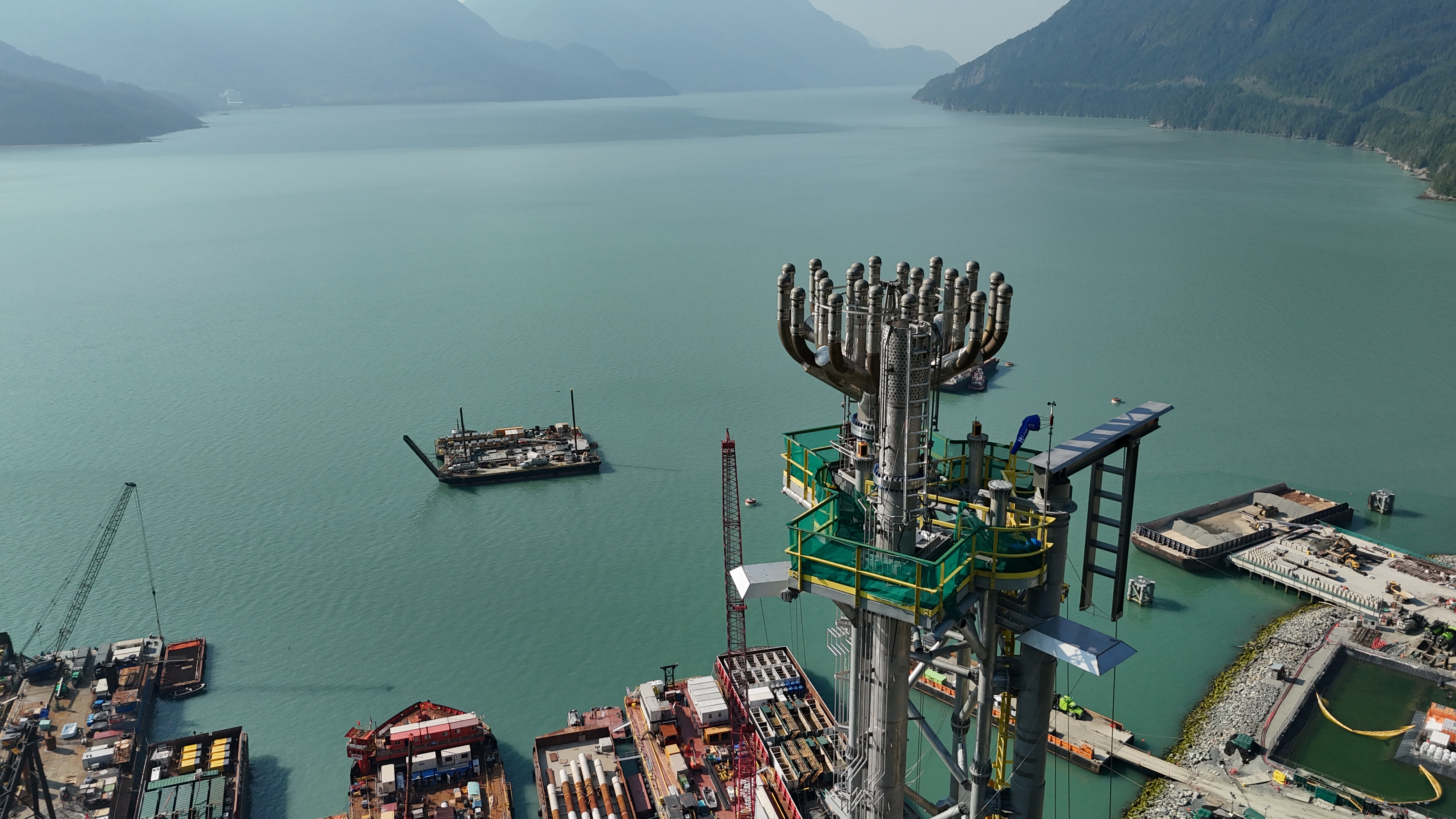
Woodfibre LNG's flarestacks with wildfire smoke in Átl’ḵa7tsem / Howe Sound on July 21, 2026.
Credit: Citizens Monitoring Group
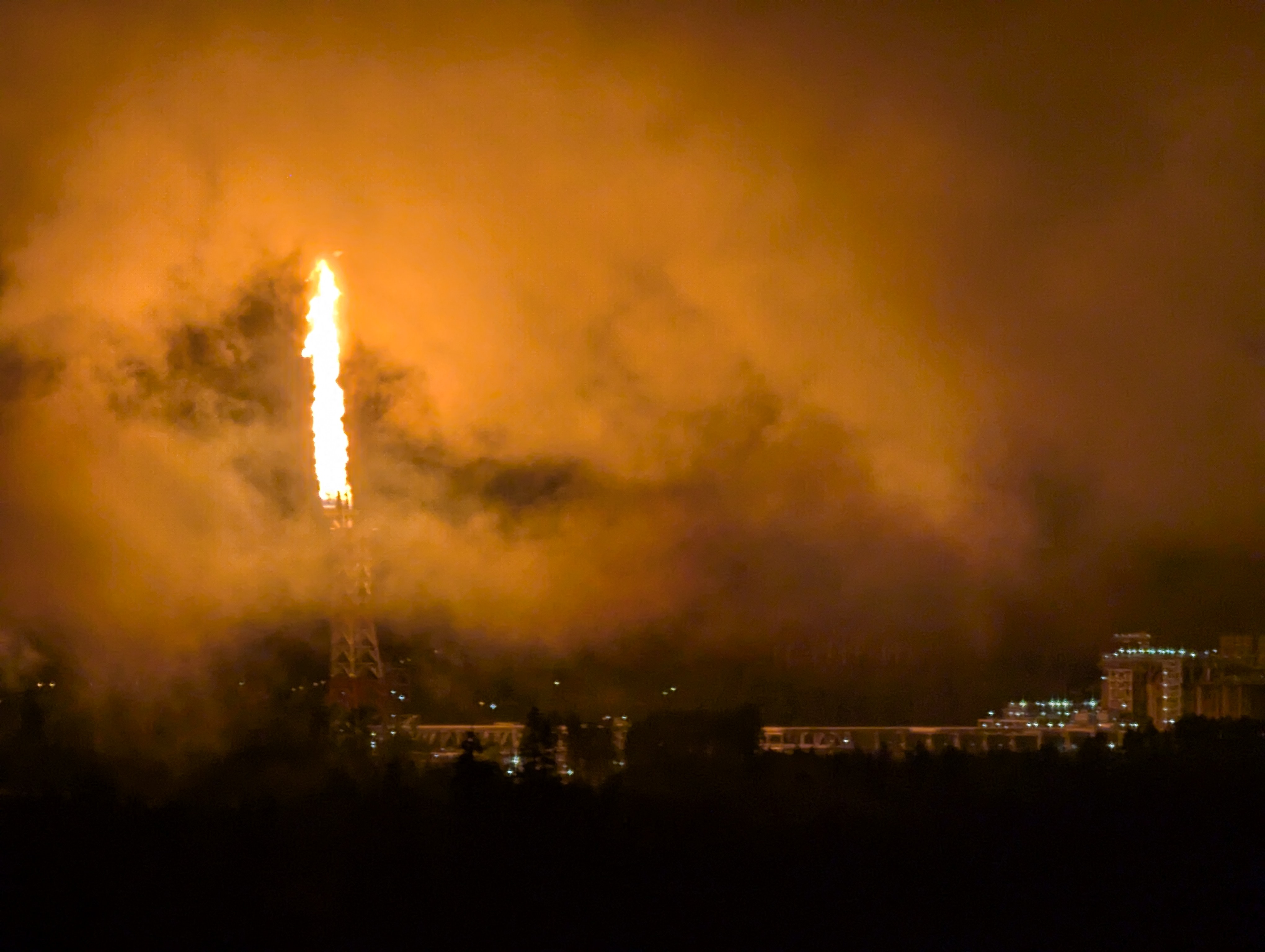
90 metre high flare at LNG Canada in Kitimat, on June 17, 2025.
Credit: Citizens Monitoring Group