Real-world evidence exposes holes in Ottawa/BC reliance on industry’s emissions modelling to permit LNG projects
Metro Vancouver faces proliferation of unmonitored hydrocarbon pollution, if FortisBC’s Tilbury LNG expansion approved
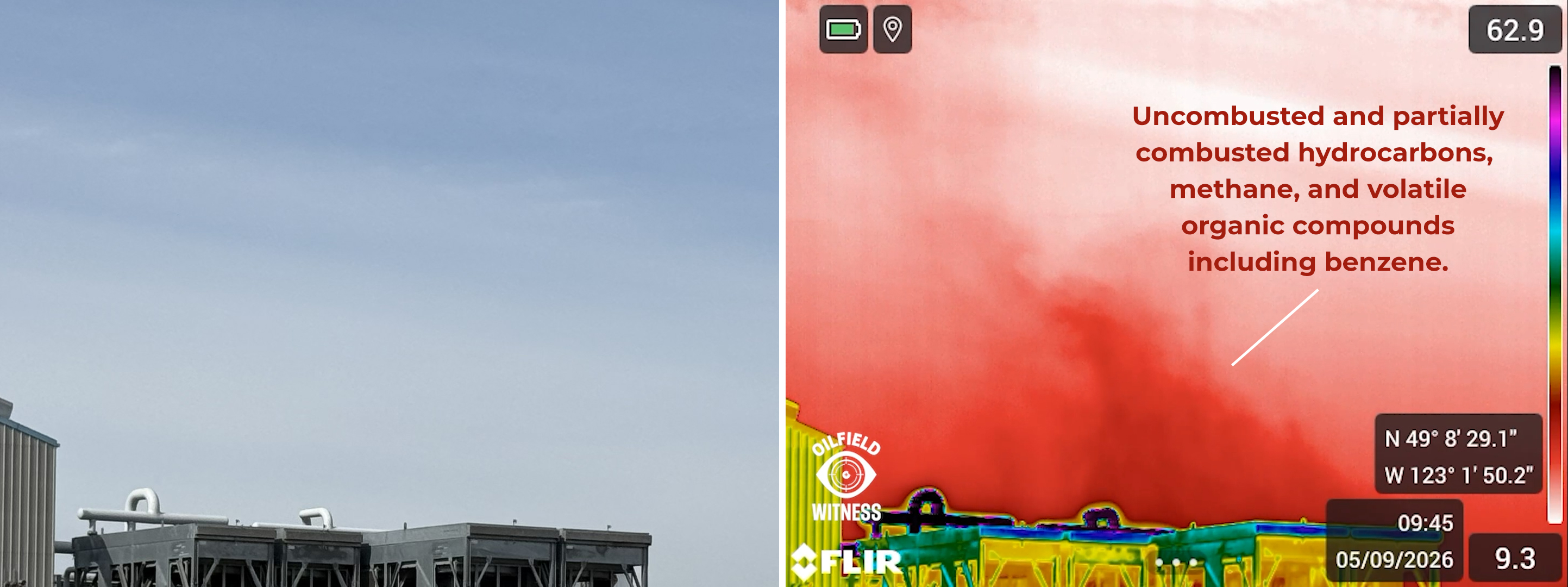
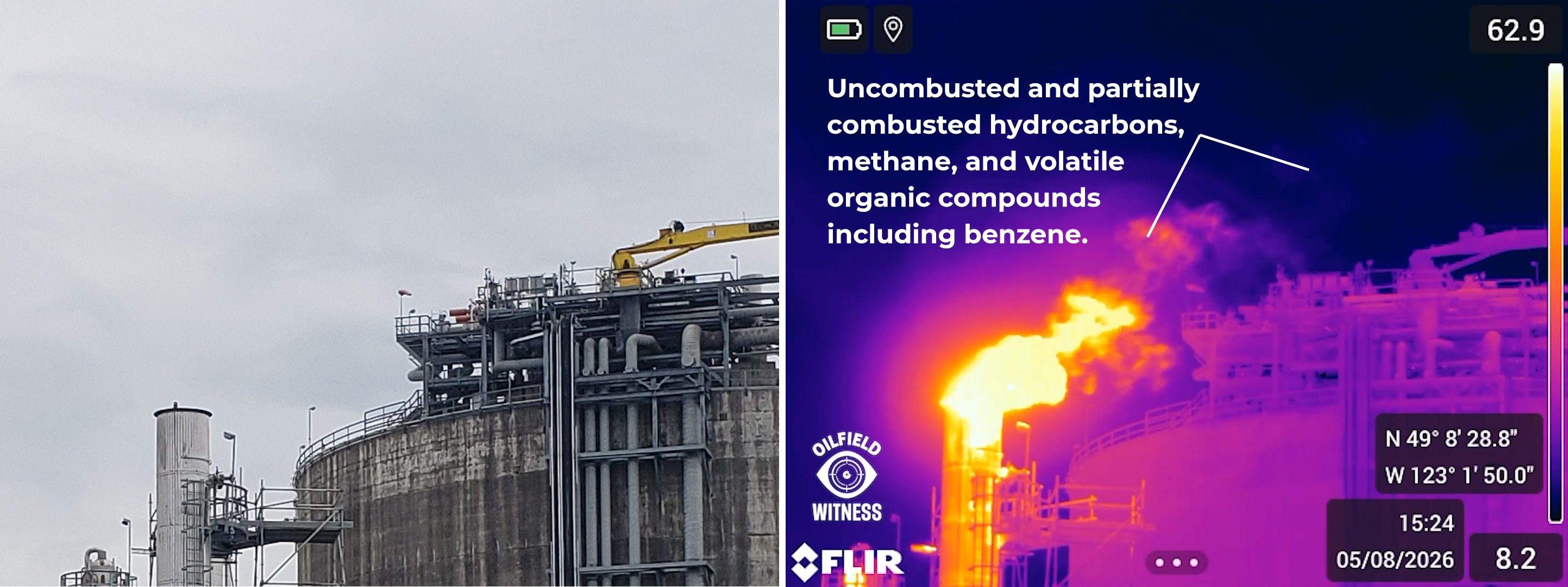
Unceded territories of the xʷməθkʷəy̓əm, Sḵwx̱wú7mesh and səlilwətaɬ Nations | VANCOUVER, B.C. | July 21, 2026 — New optical gas imaging (OGI) shows FortisBC’s Tilbury LNG is releasing unmonitored and uncontrolled amounts of harmful uncombusted and partially combusted pollutants, as part of the facility’s current operations. At this very moment, expansion plans for the facility, located in Metro Vancouver on the Fraser River in Delta, are actively underway, and—if approved—would impact the air quality of residential neighbourhoods in Delta, New Westminster, South Vancouver, Richmond and Surrey.
The Minister of Energy and Climate Solutions recently emphasized—in correspondence to dozens of organizations asking governments to apply transparent and comprehensive carbon accounting in evaluating the full lifecycle emissions of LNG projects, and mandate an industry-funded independent, cumulative health impact assessment for British Columbia’s gas and LNG industry that can inform B.C. and other jurisdictions—that LNG projects in Canada are approved using industry-developed emissions modelling and assumptions. These provide predicted concentrations of potential exposures to air pollution and chemicals—all prior to operations, and seemingly without levers to address real-world emissions that surpass those modelled.
For example, LNG Canada, the country’s first export facility, has disclosed that it operates far beyond its Air Waste Discharge Authorization permit. Air pollution volumes were over 40 times those authorized between October 2025 and January 2026. Significant exceedances have continued every month through May 2026, for which the most recent data is available, when the facility’s three flares were 15, seven and four times over their permits.
At this time, Ottawa and the Province of B.C. are conducting a combined environmental assessment, led by B.C., for FortisBC’s application to increase Tilbury LNG’s liquefaction capacities by 10 times to nearly 8,000 tonnes per day (~2.8 million tonnes per year), and to build a new LNG storage tank to hold nearly 145,000 cubic metres of liquified gas. The public comment period is open until July 27, 2026.
The BC Utilities Commission has authorized FortisBC to charge ratepayers the cost of the $1-billion LNG storage tank, a component of the Tilbury LNG expansion, providing an indirect, billion-dollar subsidy to FortisBC. At the same time, households in British Columbia already experienced surges on their FortisBC residential gas bills of 18 percent in 2025 and 11 percent in 2026.
The Tilbury LNG expansion project would generate 1 million tonnes of greenhouse gas emissions every year over the course of the project’s planned multi-decade lifespan. Additionally, a ground-level flare and venting will release other toxic pollutants into the already polluted river valley. Most of these emissions are invisible to the naked eye, without specialized technology, and are harmful to the climate and human health.
New Westminster is the latest municipality in British Columbia to call for a cumulative, independent health impact assessment of LNG infrastructure, joining Squamish, Dawson Creek, Hazelton, and Terrace, as well as the Squamish Lillooet Regional District, the Health Officers Council of B.C., and more than 50 organizations across the country.
Tim Doty, an ITC Level III Master Thermographer and technical advisor to Texas-based nonprofit Oilfield Witness, documented pollution at the existing Tilbury LNG facility on May 8 and 9, 2026, using specialized optical gas imaging technology. He says; “I worked as a regulator in Texas for almost three decades, and this technology is the gold standard per the U.S. Environmental Protection Agency (EPA). Every LNG facility that I have surveyed in Texas, Louisiana—and now two in British Columbia—has been a big emitter. You won’t see much of the air pollution with the naked human eye unless you use OGI technology and that’s something industry, government, and regulators already know.”
QUOTES
City of New Westminster Mayor Patrick Johnstone
“As local communities continue to carry the burden of climate disruption with murderous heat domes, shifting flood patterns, wildfire devastation and choking summer smoke, it is unconscionable for senior governments and corporations to be throwing fuel on the fire. There is no moral case for fossil fuel expansion while our cities burn, and any alleged short-term economic gain comes only with downloading costs to local taxpayers and a continued degradation of our quality of life."
Tim Doty, technical air monitoring expert for almost 30 years at the Texas Commission on Environmental Quality; ITC Level III Master Thermographer; current Technical Advisor to Texas-based nonprofit Oilfield Witness, and President of TCHD Consulting LLC
“At Tilbury LNG, I documented stacks, vent pipes, and processing units continuously spewing emissions that were actively filling the airshed with pollution, both overhead and downwind, and we’re not talking about heat, the technology confirmed that. These are largely uncombusted hydrocarbon emissions that include but are not limited to methane and volatile organic compounds that people really need to be concerned about from environmental, climate, and human health standpoints.”
Diane Milsom, concerned resident
“I live here. I also boat up and down the coast. I understand the huge implications there would be for pollution in the community, accidents on the Fraser and Salish Sea, and fracking inland. We know this kind of project brings pollution, having this camera footage just proves how severe the problem is and how important it is that the government refuses to grant the project certificate.”
Tracey Saxby, marine scientist and executive director of My Sea to Sky
“LNG expansion in close proximity to urban centres is reckless, especially when it lacks controls and effective pollution monitoring. Governments in Canada are not monitoring LNG emissions adequately, and there are big monitoring gaps that should concern everyone. Our governments need to act and use the levers they have to hold companies like FortisBC and LNG Canada accountable for this harmful air pollution and protect public health.”
Janelle Lapointe, senior adviser indigenous strategies at David Suzuki Foundation
“The public is being asked to pay for Tilbury LNG twice: first through rising utility bills, and again through the extreme weather and air pollution that this fossil fuel expansion will intensify. Indigenous and rural communities continue to experience the disproportionate impacts from climate chaos, but Tilbury LNG shows how quickly the boundaries of the sacrifice zones are expanding. The risks and impacts that may have been out of sight and out of mind are arriving at our doorstep. But none of this is inevitable: we can refuse to accept the financial, health and environmental costs of fossil fuels and instead invest in clean energy that makes our communities safer, healthier and more affordable.”
Thomas Green, senior manager climate solutions at the David Suzuki Foundation
"FortisBC's case for Tilbury LNG expansion doesn't hold up because global LNG markets are heading into a glut. Adding more supply into a softening market, when BC already has millions of tonnes of LNG capacity under construction at LNG Canada, Woodfibre LNG and Cedar LNG, is a risky bet that could prove expensive for ratepayers and taxpayers. We don't need to build a bigger LNG terminal to find out that betting on gas expansion in a glutted market is a bad deal, for our air, our climate and our wallets."
Anna Barford, Oceans Campaigner, Stand.earth
“FortisBC is applying to expand the Tilbury LNG facility beyond recognition, but they don’t have their permits yet and we have the opportunity to stop the bad idea before it is too late. Plans include an industrial flare polluting local air, enough liquefaction to fulfill their export license and over 100 tanker voyages per year, not to mention construction noise and increases to our utility bills in the short term. Orcas, Salmon, and our future selves need us to speak up now in opposition to dangerous gas expansion.”
Dr. Tim Takaro, BC-based physician-scientist in environmental medicine, public health and toxicology and representative of the Canadian Association of Physicians for the Environment
“The question isn’t whether people will share the same air as this facility. They already do. Communities in the Lower Fraser River and delta region share the same airshed, and air pollution doesn’t stop at the plant boundaries. Before approving an expansion of this scale, governments have a responsibility to ensure decisions are based on an accurate picture of what people are actually breathing, not simply what models predict. When pollution monitoring leaves significant gaps, it is harder to protect the health of nearby communities, especially children, older adults and people living with heart or lung disease.”
– 30 –
MEDIA RESOURCES
High-resolution images + b-roll of OGI footage, taken by former regulator Tim Doty, at Tilbury LNG in May 2026.
BACKGROUNDER
What is Optical Gas Imaging? Optical gas imaging (OGI) technology allows us to see the invisible pollution from oil and gas facilities by using a Teledyne FLIR G620 optical gas imaging camera that is calibrated to detect hydrocarbons, methane and volatile organic compounds (VOCs).
What can the OGI camera see? The OGI camera detects gases in the 3.2 to 3.4 micrometer wavelength band of the electromagnetic spectrum. Humans see in the 0.4 to 0.7 micrometer range (visible light). The OGI camera allows us to “see” hydrocarbon, methane, and VOC pollution that would otherwise be invisible to the naked eye.
What is in the gas? This OGI footage shows uncombusted and partially combusted hydrocarbons, methane, and VOCs, including benzene, being released from the Tilbury LNG facility in Delta. The OGI camera cannot speciate the gases, but it can show the movement of the gases as they are released into the airshed.
Is this a leak? No, this is the intentional release of harmful pollutants. The OGI camera captures the movement of the gases that are being released that would otherwise be invisible to the naked eye.
Is this heat? No, the temperature span scale on the right side of the videos shows the approximate temperature of the gases as they are released into the airshed.