BC Energy Regulator approves higher-threshold pollution permit for FortisBC
A pipeline of pollution straight into Howe Sound
Vancouver, BC | July 10, 2026 — The BC Energy Regulator has approved an amendment to FortisBC’s waste discharge permit, enabling up to 6,815 m3/day of effluent, laden with heavy metals to be discharged into the Átl’ḵa7tsem / Howe Sound Biosphere Region. This is over four times more than the original permit allowed, and follows disclosures that the company has been violating its original permit for over a year, releasing 365 million litres of effluent—double its original permit—into the marine environment.
My Sea to Sky and the Sunshine Coast Conservation Association are calling for the BC Energy Regulator to pause the permit amendment and investigate the discharge point as the toxic effluent is flowing into the Átl’ḵa7tsem / Howe Sound Biosphere Region.
The toxic wastewater has exceeded Federal and Provincial water quality guidelines for copper and aluminum on an almost weekly basis since December 2024. Both copper and aluminum are known to be highly toxic to marine life.
The new permit allows FortisBC to:
- Increase discharge effluent by over four times: from 1,500 m³/day to 6,815 m³/day);
- Discharge copper at levels ~18 times higher than BC Water Quality Guidelines;
Patrick Canning, legal counsel for My Sea to Sky, says: “Section 16 of the Environmental Management Act gives power to amend permits which have already been granted, but only if the amendments are ‘for the protection of the environment.’ That’s not the case here. This is about cutting costs and enabling construction timelines to benefit a mostly foreign-owned fossil fuel project.”
“Canada’s ‘clean’ LNG industry has a pipeline of pollution that runs directly into the fragile marine ecosystems of the Átl’ḵa7tsem / Howe Sound Biosphere Region. This is a clear regulatory failure. Instead of holding FortisBC accountable to the original permit, the BC Energy Regulator has allowed FortisBC to pollute even more. Two years ago, we warned the regulator that FortisBC's water treatment system for the Eagle Mountain to Woodfibre Gas Pipeline project was inadequate and that it would fail to meet requirements. FortisBC has broken its promise to halt effluent discharge from the tunnel if water quality guidelines were not being met,” says Tracey Saxby, marine scientist and executive director of My Sea to Sky.
Suzanne Senger, executive director of the Sunshine Coast Conservation Association, says; “Átl’ḵa7tsem / Howe Sound is designated as a UNESCO Biosphere Region and recognized internationally as a cultural and ecological treasure. Increasing pollutants and weakening water-quality protections violates the principles of a UNESCO Biosphere Region and risks undermining the hard-fought ecological recovery of Howe Sound. The regulator should make FortisBC stop work on the tunnel until they control the excessive flow of wastewater and upgrade the water treatment system to meet water quality guidelines.”
Note to editors: As required by the Public Notification Regulation, FortisBC did not complete the required BCER application. In lieu, FortisBC sent in a memo from a contractor to act as an application, so the BCER should never have approved this non-compliant “application.”
– 30 –
Proximity of the discharge point to Howe Sound
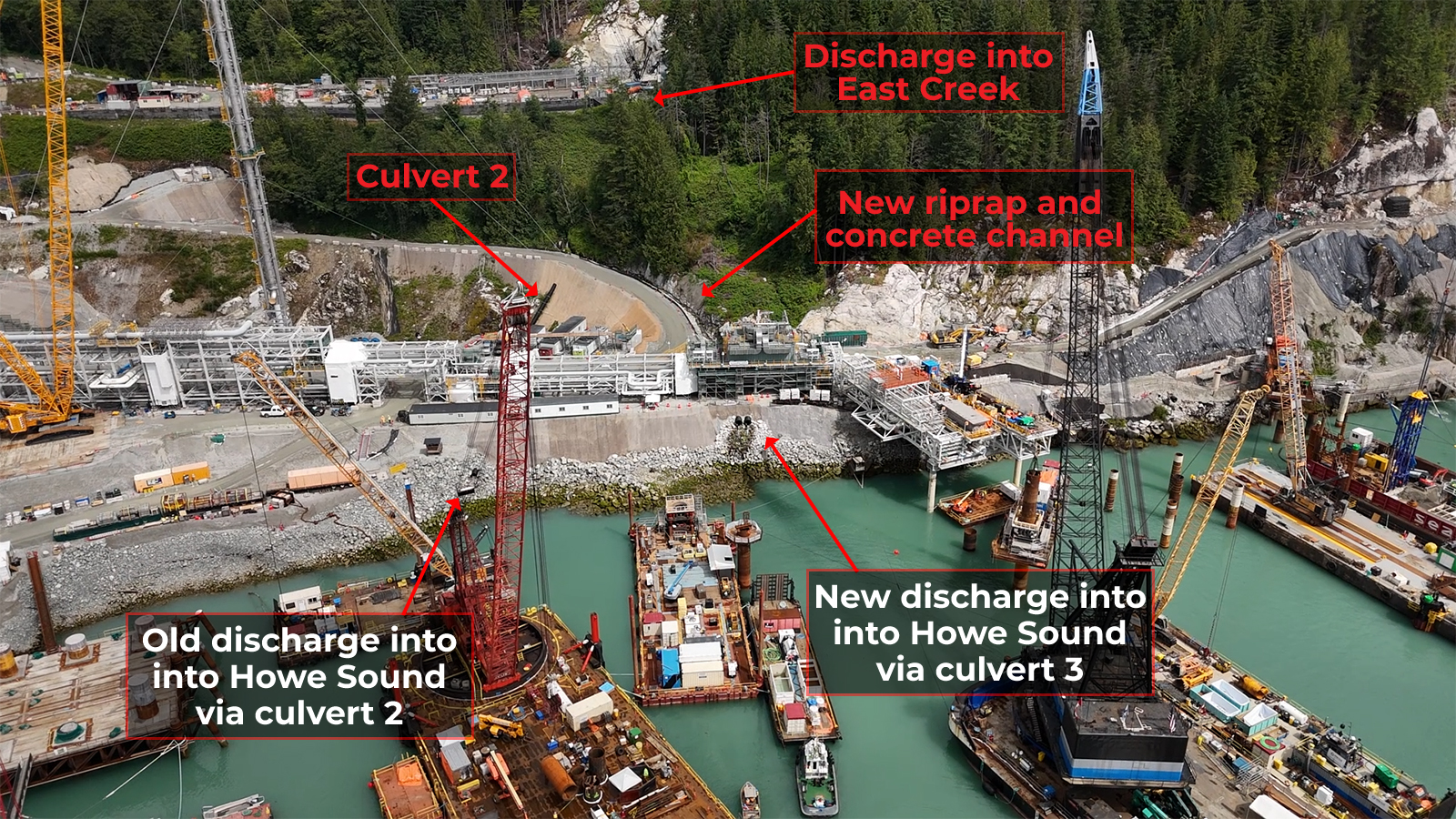
According to pages 13-15 of the “application,” FortisBC is discharging wastewater laden with heavy metals into a highly modified stream, a mere 170 metres upslope from Howe Sound. Less than 50 metres of the natural stream remains, the rest is an excavated channel armoured with riprap and concrete, ending in two pipes that discharge directly into Howe Sound.
FortisBC’s original permit application states that direct discharge into Howe Sound was not considered due to “anticipated concerns from First Nations and the public from discharging directly onto the marine environment; cost and schedule implications from requiring to conduct a year-long sampling program to determine background conditions of the receiving environment; and the need to develop a comprehensive mitigation and monitoring plan due to potential environmental impacts to marine ecosystems.”
Resources for Media
- Photographs and videos of FortisBC’s tunnel portal at the Woodfibre site can be accessed here.
- FortisBC’s current waste discharge permit PE-110163 can be accessed here.
- FortisBC's application to amend the permit at the Woodfibre site (and past permit applications) can be accessed here. Relevant documents are:
- FortisBC's weekly water quality testing results can be found here.
Background information
FortisBC is currently constructing the Eagle Mountain–Woodfibre Gas Pipeline to feed piped gas to the Woodfibre LNG export project in Átl’ḵa7tsem / Howe Sound. The pipeline includes a 9-km tunnel under the Skwelwil’em Squamish Estuary and Wildlife Management Area (WMA). FortisBC is tunneling through 5.2 km of granite bedrock and has encountered potentially acid-generating rock, which is what made Britannia Mine the most polluted site in North America for nearly a century.
History of acid rock drainage from the Britannia Mine
For much of the 20th century, acid rock drainage from the Britannia Mine poured massive amounts of toxic, metal-laden water into Átl’ḵa7tsem / Howe Sound. The pollution created a "dead zone" in nearby ecosystems, devastating marine life for decades. After the mine closed in 1974, it took decades of advocacy, regulatory reform, remediation, and sustained stewardship by First Nations, scientists, volunteers, and local government to clean up the mess at public expense.
About My Sea To Sky
My Sea To Sky is a people-powered environmental organization that was founded in 2014 to defend, protect, and restore Átl’ḵa7tsem / Howe Sound, www.myseatosky.org
About Sunshine Coast Conservation Association
The SCCA is a charitable non-profit society dedicated to conserving and restoring biodiversity in Howe Sound and the Sunshine Coast. We develop and lead transformative conservation campaigns to protect watersheds, ecosystems, and species through research, education, alliance-building, and advocacy in the territories of the Sḵwx̱wú7mesh, shíshálh, Tla'amin, Klahoose, and Homalco First Nations, www.thescca.ca